

 4 min read
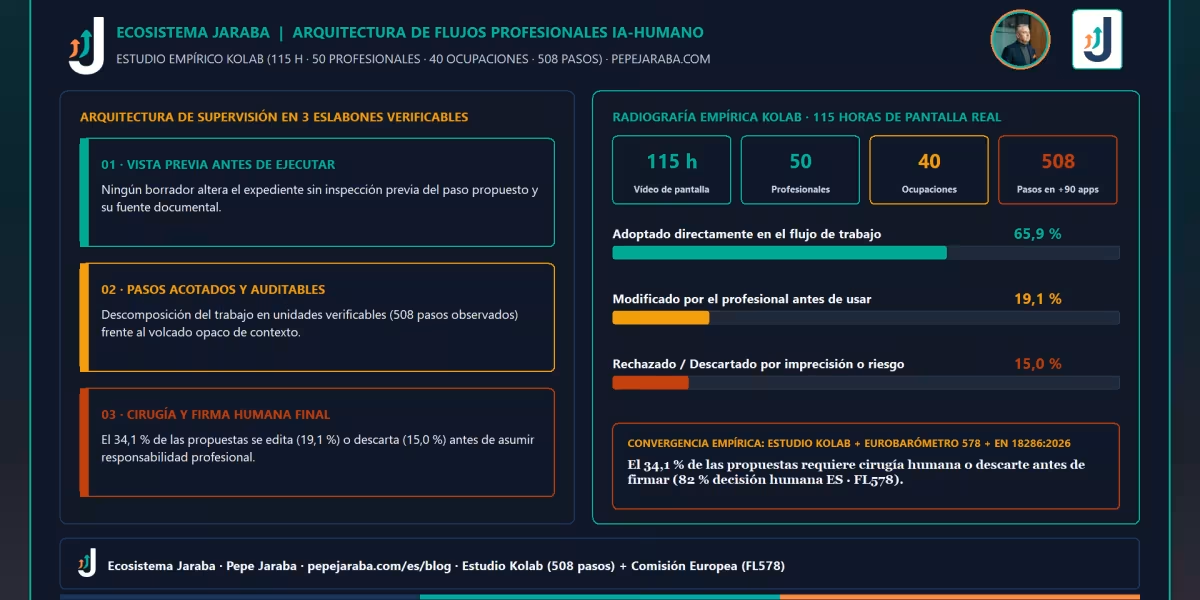
The Kolab empirical study analyzes 115 hours of real screen recordings across 50 professionals in 40 occupations, evaluating 508 workflow steps executed across more than 90 software applications. Its findings prove that 65.9% of artificial intelligence outputs are adopted directly, 19.1% are modified by the professional, and 15.0% are rejected (34.1% require human surgery or discard before signing).
| Observed outcome across 508 steps | Percentage and visual bar | Operational meaning before signing |
|---|---|---|
| Adopted directly | 65,9 % | Well-scoped drafts and lookups that pass professional verification without rewriting. |
| Modified by the professional | 19,1 % | Outputs with useful structure that require technical surgery, statutory adjustment, or stylistic refinement. |
| Rejected / Discarded | 15,0 % | Outputs discarded due to inaccuracy, missing context, or mismatch with actual procedural rules. |
| Total requiring human intervention (19,1 % + 15,0 %) | 34,1 % | Over one in three outputs requires human surgery or discard before a professional signs off. |
Three practical lessons for law firms, SMEs, and the public sector
1. Mandatory preview before executing any change
When 34.1% of steps require modification (19.1%) or outright rejection (15.0%), no tool should overwrite a legal brief, tax filing, or public tender blindly. Every professional workflow needs a clear preview verified against Official Gazette sources.
2. Break work into verifiable steps instead of dumping raw context
Across the 508 steps observed in +90 applications, dumping massive raw context increases the 15.0% rejection rate. Breaking tasks into verifiable steps —facts, statutory articles across the 17 Core Laws and 181 regulations, deadlines across all 8,131 INE municipalities, and draft review— ensures auditability.
3. Human signature supervision and convergence with Eurobarometer 578 and EN 18286:2026
Kolab's 34.1% human intervention rate mirrors European Commission Flash Eurobarometer 578 in Spain (where 82% keep human final decision-making and 75% require process adaptation) and the first harmonised EU AI Act standard (Decision EU 2026/2274 · EN 18286:2026).
Frequently asked questions on the Kolab study and professional AI supervision
What did the Kolab empirical study analyze?
It analyzed 115 hours of continuous screen recordings from 50 professionals across 40 occupations, documenting 508 workflow steps across more than 90 software applications.
What percentage of AI proposals is adopted, modified, or rejected?
65.9% (65,9 %) is adopted directly, 19.1% (19,1 %) is modified by the professional, and 15.0% (15,0 %) is rejected or discarded, totaling 34.1% (34,1 %) requiring human intervention.
Why does a 34.1% edit/reject rate require preview and verifiable steps?
Because more than one-third of outputs need expert surgery or rejection before entering the client's case file and physical/digital AZ+QR archive.
How does this connect to Flash Eurobarometer 578 and EN 18286:2026?
It empirically confirms why 82% of Spanish SMEs retain human final decision-making and why EU Implementing Decision 2026/2274 (EN 18286:2026) mandates a documented quality management system.



Conversation 0
Has something similar happened to you, or do you see it differently? Share your thoughts here.
No comments yet. Be the first to start the conversation.