

 7 min read

For the past two years, much of the debate surrounding artificial intelligence in professional firms and SMEs revolved around which model drafted better or which instruction template saved a few minutes. That debate has now been legally superseded in the Official Journal of the European Union.
Through Commission Implementing Decision (EU) 2026/2274 of 12 October 2026 (published in the Official Journal of the European Union, L Series, on 14 October 2026, reference OJ:L_202602274 · DOUE-L-2026-81573 · CELEX 32026D2274 · ELI: http://data.europa.eu/eli/dec_impl/2026/2274/oj, and highlighted by Directorate-General CONNECT on 21 October 2026), the European Union has published in its Annex the reference for the first harmonised standard in support of Regulation (EU) 2024/1689 (Artificial Intelligence Act):
EN 18286:2026 — «Artificial intelligence: quality management system for regulatory purposes of the EU Artificial Intelligence Regulation»
The first harmonized standard published in the Official Journal for the AI Act's deployment, focusing not on an isolated algorithm but on the Quality Management System (Art. 17 and Art. 40 of the AI Act), sends an unequivocal message to the entire European market: legal certainty does not lie in standalone prompts, but in operating under a governed, documented, and auditable work system.
1. What Exactly Does Implementing Decision (EU) 2026/2274 (OJEU-L-2026-81573) Establish?
The legal act signed in Brussels confirms six fundamental regulatory milestones:
- Presumption of conformity (Recital 1 and Art. 40 of Regulation (EU) 2024/1689): In accordance with Article 40 of the AI Act, high-risk artificial intelligence systems and models that comply with harmonised standards whose references have been published in the Official Journal of the European Union benefit from a presumption of conformity with the essential requirements covered by those standards.
- Standardisation Mandate C(2025) 3871 (Recitals 2 and 3): In response to the standardisation request issued by the Commission to CEN and Cenelec in Implementing Decision C(2025) 3871 (Annex I, point 9), both European bodies completed work on the quality management systems for artificial intelligence system providers, including post-market surveillance processes, resulting in standard EN 18286:2026.
- Joint Evaluation and Official Publication (Recitals 4, 5, and 6 and Articles 1 and 2): Following the evaluation by the Commission, together with CEN and Cenelec, that EN 18286:2026 conforms to mandate C(2025) 3871 and meets the requirements laid down in Regulation (EU) 2024/1689, its reference is published in the Annex to the Official Journal, entering into force on the day of its publication (October 14, 2026).
2. Evidential Rigor and Real Legal Scope: What EN 18286:2026 Covers and What It Doesn't
In serious professional practice, it is advisable to separate regulatory facts from marketing slogans:
- Distinction between the public legal act and the technical standard: The Implementing Decision (EU) 2026/2274 (DOUE-L-2026-81573) is an act of Union law published in the Official Journal of the EU, publicly accessible and verifiable. The full technical text of standard EN 18286:2026 is a standardization document developed by CEN/CENELEC and distributed through national standardization bodies (such as UNE in Spain), subject to its corresponding intellectual property rights.
- Exact scope of the presumption of conformity (Art. 40 in conjunction with Art. 17 RIA UE): Conformity with EN 18286:2026 grants presumption of conformity regarding the requirements of the Quality Management System (Art. 17 of EU Regulation 2024/1689) —documented policies and procedures for design, quality control, verification, risk management, data management, post-market monitoring, and incident reporting—. It does not constitute automatic approval of any use of IA nor does it exempt from effective human oversight (Art. 14), from staff IA literacy (Art. 4), or from other specific obligations for each operation.
3. The Revealing Crossroads: OJEU-L-2026-81573 Addresses the 4 Bottlenecks of Flash Eurobarometer 578 in Spain
When we combine this first harmonized standard (EN 18286:2026) with the empirical overview from the Flash Eurobarometer 578 of the European Commission (12,826 SMEs in the EU27, doi: 10.2767/3975834), all the pieces fall perfectly into place for Spanish firms and SMEs:
| Official Indicator in Spain (Flash Eurobarometer 578) | Spain Data (ES) vs EU27 Average | Regulatory and Operational Response (EU Decision 2026/2274 · EN 18286:2026) |
|---|---|---|
| Q8c · Uncertainty regarding legal or regulatory standards | 60% in ES vs 49% in EU27 (+11 pp) | The publication of EN 18286:2026 in the OJEU inaugurates the harmonized technical rules of Art. 40 EU AI Act, replacing ambiguity with an auditable quality management framework (Art. 17). |
| Q8b · Lack of experience to integrate it into existing processes | 60 % in ES vs 48 % in EU27 (+12 pp) | EN 18286:2026 confirms that AI is not deployed as an isolated occurrence, but rather integrated into documented procedures, quality controls, and continuous monitoring. |
| Q1d · Requirement to adapt to internal processes | 75% require personalization, and only 6% accept a standard approach without customization (vs 35% EU27) | A Quality Management System requires procedures adapted to the operational reality of each organization, with clear exception routes and responsibilities. |
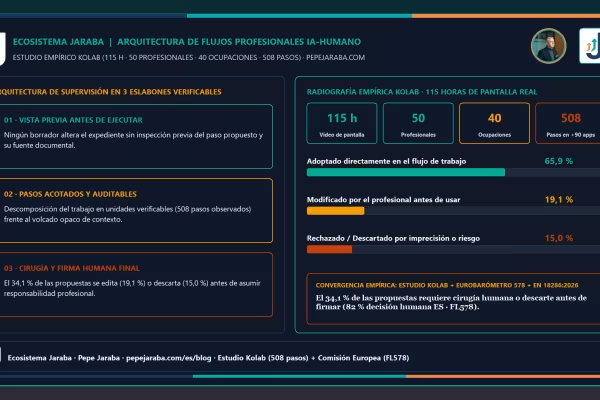
| Q3 · Human final decision and effective supervision | 82% retain final human decision in Spain (only 1% without human involvement) | The quality management system defines who reviews, who validates, and how defensible evidence is preserved before any act with external effect is issued. |
4. What This Means in Practice for a Professional Firm, Consultancy, or SME in Spain
The lesson that connects our entire series in PYME Digital PRO (PDP-05 to PDP-08) with the official publication of EN 18286:2026 is direct:
- An AI is not a work system (PDP-05): Buying access to a conversational model does not inherently create a quality management system. It requires case file structure, verifiable official sources, and traceability.
- Autonomy per operation (PDP-06): Authority is defined on an operation-by-operation basis, maintaining the 82% of human decision sovereignty already practiced by the Spanish business sector.
- Procedures with Decisions, Controls, and Exception Paths (PDP-07): Precisely the core of any robust quality management system: knowing what happens when data is missing, there's a regulatory contradiction, or professional escalation is required.
- From Technical Logs to Defensible Evidence (PDP-08): Demonstrating which current regulation from the BOE or DOUE was applied, its specific version, and the corresponding human professional validation.
Europe has already published its first harmonized technical rule in the Official Journal: the future of professional artificial intelligence belongs to work systems with verifiable quality management and human governance.
Primary sources cited: 1) European Commission, "Commission Implementing Decision (EU) 2026/2274 of 12 October 2026 on harmonised rules concerning high-risk artificial intelligence systems drawn up in support of Regulation (EU) 2024/1689", Official Journal of the European Union, L Series, 14.10.2026 (OJ:L_202602274, DOUE-L-2026-81573, CELEX 32026D2274, ELI: http://data.europa.eu/eli/dec_impl/2026/2274/oj); 2) European Commission, DG EMPL, "Flash Eurobarometer 578", April 2026 (KE-01-26-086-EN-N, ISBN 978-92-68-42706-4, doi: 10.2767/3975834).
— Pepe Jaraba


Conversation 0
Has something similar happened to you, or do you see it differently? Share your thoughts here.
No comments yet. Be the first to start the conversation.