

 5 min read

For thirty years, I have been auditing, approving, and, regrettably, witnessing European funds being returned. I have managed a Rural Development Group (GDR) for 18 years, led a public company for another 4, and signed over 500 projects involving more than 100 million euros in LEADER, PRODER, ESF+, and ERDF. I know the bureaucratic monster inside out.
And today I'm going to tell you something that no one in the boardrooms wants to hear out loud: the biggest enemy of European funds is not a lack of money. It's the "invisible bottleneck" of justification.
The Diagnosis: Millions Returning to Europe Every Year
At the close of each financial framework, millions of euros from FEDER, FSE+, and Next Generation return to Europe. Not because the projects are bad. Nor because local entities are incompetent. They return because municipal technical teams and external consultants collapse under the weight of paperwork, inflexible deadlines, and last-minute rectifications.
I've seen brilliant technical teams waste 60% of their time copying and pasting data between Excel spreadsheets, regional portals that crash, and paper files that no one has digitized. We are still managing 2026 funds with 2010 technology.
The clinical symptom: when the audit arrives, your file has "everything," but in 17 different places and 3 different formats. And traceability doesn't hold up.
The Three Leaks That Cause You to Lose 30%
When I audit an entity that has lost certification, I always find the same combination:
- Flaw 1 — The master Excel file that no one updates in real time. The same beneficiary appears with three different names on three different tabs. Upon on-site verification, you discover that two beneficiaries no longer legally exist.
- Issue 2 — The unversioned network folder. The latest version of the document is Pepe's, but Pepe left the office in September and no one knows what he renamed.
- Pitfall 3 — The 72-hour correction period that hits when no one is available. You're notified on Friday at 2:47 PM, you have until Monday at 9:00 AM, and your lead technician is on vacation. You lose the application. And with it, the grant.
The three issues share the same root cause: there is no single source of truth. Each document resides in a separate silo. And when traceability is requested, traceability simply doesn't exist — you have to reconstruct it manually.
The Paradigm Shift: From Managing Paperwork to Supervising AI
The solution is not to hire more temporary staff to put out fires at each period closing. The solution is parametric traceability.
What does this mean in practice? That the process from application to final certification is unified in a single digital ecosystem where:
- Each beneficiary exists only once, with a unique identifier and synchronized data.
- Every document is versioned, dated, and cryptographically signed.
- Each change is recorded in an audit trail that complies with Regulation (EU) 2021/1060 and Article 12 of the EU AI Act.
- AI agents automatically review consistency across the narrative, budget, and justification before corrections are submitted.
"It's not about replacing the technician. It's about empowering the technician to stop copy-pasting and focus on decision-making."
What I Would Do If I Were Running Your GDR or Public Company Today
With 30 years of experience and having lived through four different financial frameworks, I would give you these five steps in this order:
- Traceability Audit in 72 hours. Identify your vulnerabilities before the intermediate body audits you.
- Single Electronic Record. One platform, one signature, one version.
- AI Agent for Pre-review. Consistency between the proposal, budget, and tender specifications before submission.
- Executive Dashboard. The mayor, the manager, and the technician see the same KPIs in real-time.
- Automated Correction Protocol. AI alerts you, not the technician on vacation.
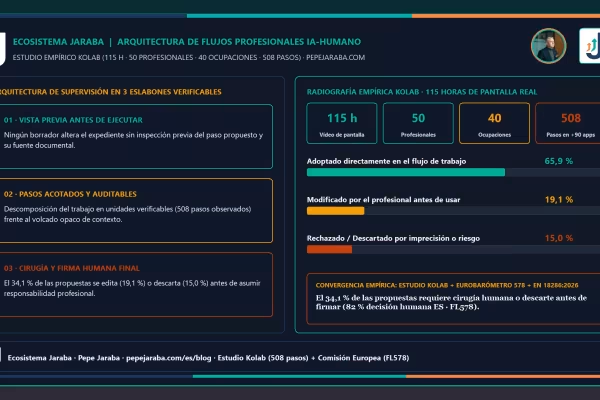
It's not science fiction. It's exactly what we've been implementing for three years in Andalusian public entities with the Jaraba Ecosystem. And the results are measurable: justification time -60%, corrections -80%, risk of fund repayment <2%.
The golden rule of the trade: when traceability is parametric, auditing is no longer a threat. It's just a SELECT.
The Next Step — If You Want to Close the Funnel Before the Next Deadline
If you manage a GDR, a city council, a public company, or a consultancy that manages EU funds and you've had this nagging issue for months, I'm not going to sell you a course. I'm going to offer you something concrete:
A 30-minute executive session where we analyze your current leakage map together and I provide you with a written action plan. No obligation and no cost.
Request an executive proposal and let's discuss your next opportunity
Performance figures (-60% justification, -80% remedies) come from pilot projects of the Ecosistema Jaraba in Andalusian public entities 2024-2026. Auditable data under NDA upon proposal signature.

Conversation 0
Has something similar happened to you, or do you see it differently? Share your thoughts here.
No comments yet. Be the first to start the conversation.