

 3 min read

The European Commission (Directorate-General for Employment, Social Affairs and Inclusion, DG EMPL) has just published the Flash Eurobarometer 578 (Driving factors and obstacles related to the work environment for the adoption of Artificial Intelligence and Algorithmic Management by SMEs and mid-caps, catalogue KE-01-26-086-EN-N, doi: 10.2767/3975834), based on 12,826 interviews with companies employing between 1 and 749 people across the 27 Member States.
When comparing the specific data from Spain (ES) against the European average (EU27), seven key conclusions emerge for any professional firm, consultancy, SME, or public entity:
Official Comparative Table: Spain (ES) vs. European Union (EU27)
| Official Indicator (Flash Eurobarometer 578) | Spain (ES) | EU-27 Average (EU27) | Strategic Insights |
|---|---|---|---|
| Q1 · Current use of AI or automated systems | 42% (14% extensive + 28% limited) | 42 % (12 % + 30 %) | Another 24% in Spain plans to adopt them (66% of the active market). |
| Q1d · Need for Business Adaptation | 75 % requires adaptation (28 % total + 47 % partial) and only 6 % accepts a standard system without adaptation | 58% adapted and 35% standard, not adapted | In Spain, generic, decontextualized tools fail; professionals demand adaptation to their real procedures. |
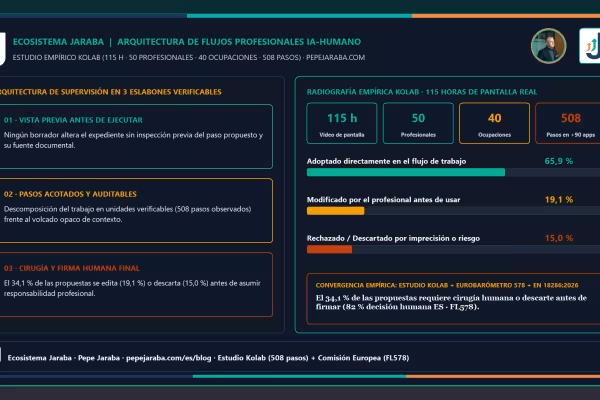
| Q3 · Who makes the decisions | 82 % final human decision (50 % AI suggests but human decides + 32 % 100 % human) and only 1 % without human intervention | 90% human decision and 2% non-human | Undelegable human supervision and signature is the overwhelming cultural and operational standard. |
| Q4 · Lack of confidence in professional and personal decisions | 53% distrust (28% + 25%) versus 39% who trust | 49 % distrust vs 44 % trust | Trust is not built with marketing: it is built with verifiable sources and traceability. |
| Q7f / Q7c / Q7a · Key drivers | 74% improve work organization, 73% improve service quality, and 67% reduce costs | 71 % organization, 75 % quality and 73 % costs | In Spain, the #1 driver is better organization of the daily workflow (74%). |
| Q8b and Q8c · The two major obstacles in Spain | 60% lack of internal expertise to integrate it into existing processes and 60% uncertainty regarding legal/regulatory standards | 48% lack of internal experience and 49% legal uncertainty | Spain surpasses European concern by +12 and +11 points regarding how to integrate it into the process and with what legal certainty. |
| Q8d · Fear of increased surveillance | 38% identify it as a significant difficulty | 33% in the EU-27 | It demands separating work coordination and team handover from any punitive surveillance. |
| Q9 · Factor #1 for building team trust | 46% Staff training, 33% clear information on how decisions are made, and 26% human review/override | 35% training, 30% clear information, and 36% human review | Spain leads the demand for real training (+11 points over the EU), in direct alignment with Article 4 of the European AI Regulation. |
Conclusion from the Jaraba™ Method
Official data from the European Commission confirms what we observe daily in law firms, consultancies, and public administrations: the obstacle in Spain is not the rejection of technology, but rather the lack of a governed work system that integrates clear processes (Q7f: 74 %), real sectoral adaptation compared to generic solutions (Q1d: 75 % vs 6 %), regulatory rigor verified against official sources (Q8c: 60 %), final human decision (Q3: 82 %), and practical training for teams (Q9: 46 %).

Conversation 0
Has something similar happened to you, or do you see it differently? Share your thoughts here.
No comments yet. Be the first to start the conversation.